
We support Restoration of Natural Habitats
The Wairahi Tracks group initially worked to restore two areas at Langs Beach. The first was Langs Beach Scenic reserve, the entrance to which is across the road from the carpark .This reserve is administered by the Department of Conservation. The second was the area on both sides of the river along Cove Road when entering Langs from the South. This path through this area is now called the Nikau Forest walk and runs from the bridge at Lang Cove to the bridge at the entrance to Langs Beach Estate. The grassy area leading to the Nikau Forest walk is administered by the Whangarei District Council.
Over the past few years and as the focus of the group has widened to include all the tracks mentioned above, the work has grown and many hours of volunteer labour have been required to remove invasive weeds and start to restore the natural habitat.
Our work follows the Habitat Restoration Methodology:
Planning - This involves exploring the site to understand the physical terrain, identify the existing native vegetation and any weeds that require treatment or removal. For significant sites, we seek expert advice on suitable species to plant and where these are best located. This stage often involves consultation with land owners within or adjacent to the target area, as well as Council, DOC or QEII.
Access - In many places, access tracks are required to enable us to perform the necessary site preparation (eg weed removal) and eventually to bringplants and people into the target sites. Eventually, these access tracks are often upgraded at the end of the project to facilitate ongoing maintenance, pest control and public access.
Clearing - This involves clearing the site of any inorganic material (eg rubbish) and the treatment or removal of significant infestations of weeds so that planting can be performed efficiently and effectively.
Planting (Stage 1) - This involves establishing the foundational level of re-vegetation - often plant species designed to grow quickly and colonise the site, quickly creating shade that helps to suppress weeds, protect the soil and any waterways.
Releasing - This essential and onerous stage involves ensuring the new plantings aren't smothered and overcome by the inevitable return of any previous weed species, clearing around the new plantings ensures they get the best opportunity to survive and thrive. Without this step, many plantings simply revert to their previous weed-infested state
Planting (Stage 2) - This stage involves introducing a different set of plant species intended to eventually form the mature canopy cover for the regenerating forest, typical species are the larger podocarps: (rimu, kaihikatea, rewarewa etc)
Weed Control - this is required for a number of years until the new plantings mature to the stage where they dominate and naturally suppress most weed species, although many shade tolerant weeds require continual control - even in established forests.
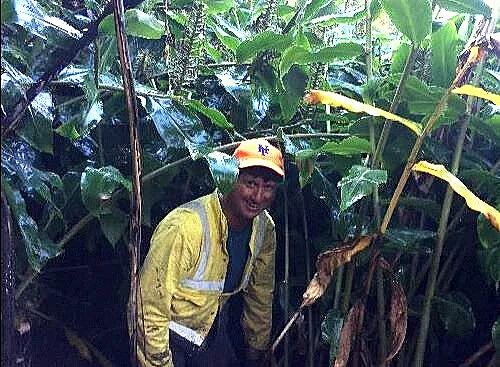
Even across our relatively small area the challenges differ from track to track. When work first began in the Langs Beach Reserve the most overwhelming problem was vast areas of head-high ginger plants. The task seemed impossible. Many days of weed whacking and slash and paste techniques by local and DoC volunteers were needed to get rid of the majority of the ginger. Then volunteers tackled infestations of climbing asparagus fern, blackberry, pampas, woolly nightshade, and cotoneaster. The reserve is a natural wetland, and we are now following a planting plan commissioned from “Rural Design.”
In the Nikau Forest area the pest plants included climbing asparagus fern, ladder fern and many montbretia and watsonia bulbs that required hand removal. We sprayed and weeded jasmine, pampas, onion weed, nasturtium, and morning glory, as well as out of control wisteria that was smothering the trees.
The shared user path from Langs to Bream Tail road presented a new and interesting challenge. The path crosses an ‘ephemeral wetland’ created by an ancient kauri forest. This has created very different soil conditions and vegetation which need to be manintained in their present state.
And on the coastal walkway, a steep slope buffeted by coastal winds and storms we’ve needed to consider hardy coastal plants and native flaxes to stabilise the steep clay slopes.

Predator Control
Predator control has been undertaken in the Langs Beach Scenic Reserve since December 2020 under the guidance of Waipu Kiwis. Targeted species are predominantly rats, possums and stoats. A network of traps has been placed throughout the reserve utilising the access tracks that have been constructed by the Wairahi Tracks Charitable Trust. This comprises 10 possum traps, approximately 15 rat traps and 5 stoat traps. The traps are complemented by the use of a track camera to ensure the traps are placed in optimal locations and most desirable lures are used.
There are currently low numbers of predators being trapped in the reserve – time will tell whether this is seasonal or if we have managed to get them under control, although it seems that it is reasonably easy to catch the young and naïve animals but much harder to capture the older wiser ones that can be trap shy. We are hoping that as a result of the predator control being undertaken in the reserve and adjoining properties there will be an increase in bird life after this nesting season and one day we will be able to hear bellbird (korimako) and kiwi in our local area.
If you would like to take part in this rewarding (and fitness-building!) activity, please contact Kathryn via email to info@wairahitracks.nz.